Freddie T. Usita, 50, a mushroom grower who owns the Usita Mushroom Farm in Barangay 10, Arua-ay, Piddig, Ilocos Norte, said there is no need to go abroad to earn a high income. His story reflects a growing trend in the Philippines, where more farmers and returning OFWs are turning to mushroom cultivation as a profitable agribusiness.
According to the Philippines Mushroom Industry Outlook 2022–2026, local mushroom production is projected to reach 743 metric tons by 2026, growing at an annual rate of 1.3%. This steady rise is driven by increasing demand for healthy, plant-based food and the low startup cost of mushroom farming.
“We have a lot of opportunities in our country; we only need to be more creative, patient, and persevering,” shared Usita.
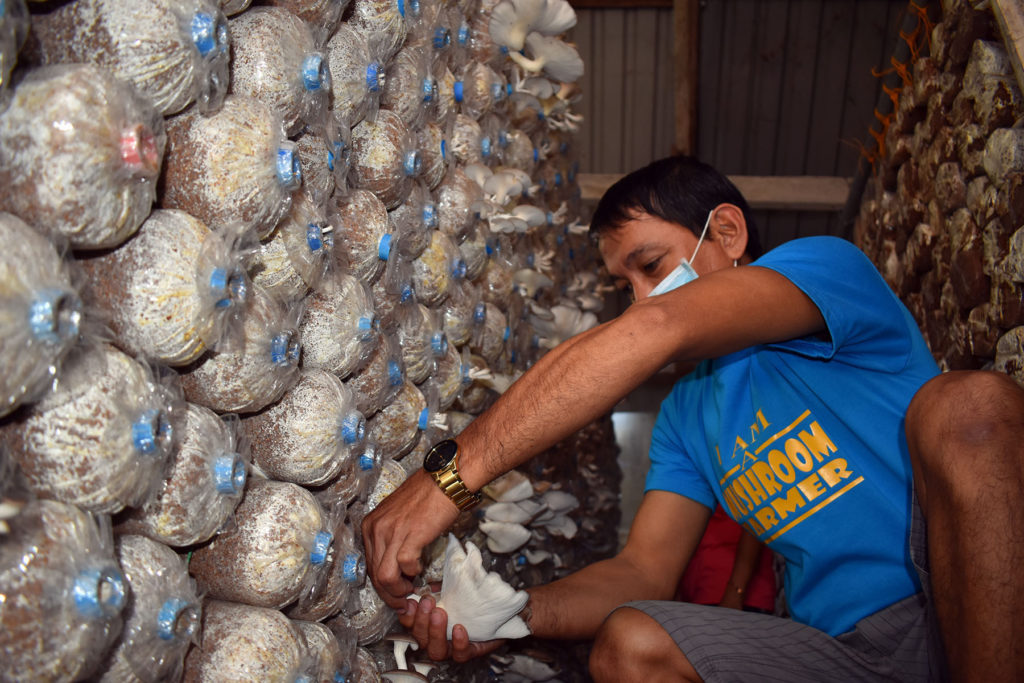
From OFW to successful farmer
Usita worked as a welder in Taiwan until the company he worked for transferred operations to China, leaving him unemployed. Returning home, he faced uncertainty about his family’s future. He initially tried quail production but failed due to lack of technical knowledge.
In 2011, he attempted backyard mushroom production but failed again. Instead of giving up, he enrolled in a short-term course on mushroom production (Horticulture NCII) at the Marcos Agro-Industrial School, a TESDA-accredited institution in Ilocos Norte. There, he learned essential skills such as tissue culture, spawn creation, and fruiting bag production.
Armed with proper training, he revived his mushroom farm—and this time, succeeded.
Growing a sustainable agribusiness
Within a few years, Usita’s mushroom venture expanded steadily. He now supplies fresh oyster mushrooms not only within Ilocos Norte but also to nearby provinces like Ilocos Sur and Cagayan. His farm produces both white and gray oyster mushrooms, two of the most in-demand varieties in the Philippines.
His success mirrors national trends. A 2025 market analysis by Ken Research valued the Philippine mushroom market at USD 1.4 billion, driven by rising consumer demand for healthy, locally sourced food. Oyster mushrooms remain the most popular due to their fast growth cycle and high profitability.
Income breakdown: How mushroom farming pays off
Freddie and his wife now earn an average net income of ₱27,500 per month from mushroom production alone—significantly higher than the average farmer income in the region.
Here’s how his numbers work:
- 2,500 fruiting bags in production
- ₱15,000 total production cost (sawdust, lime, rice bran, cellophane, labor)
- 250 grams average yield per fruiting bag over four months
- 625 kilograms total harvest
- ₱200 per kilo market price in Ilocos
- ₱125,000 gross revenue per cycle
He also earns additional income by selling fruiting bags at ₱20 each to aspiring growers.
“We maintain continuous production to sustain supply for our regular clients,” he said.
Zero waste: Turning by-products into profit
All spent fruiting bags are decomposed into organic fertilizer or used for vermicomposting—reducing waste and creating additional value. This aligns with sustainable farming practices promoted by the Department of Agriculture.
Transforming income into long-term stability
Through mushroom farming, Usita was able to purchase 2,800 square meters of agricultural land, buy a vehicle, and build substantial savings. His mushroom income supports his children’s education—one in senior high school and another who already finished college and now works in a BPO company.
He also provides livelihood opportunities to his community by employing three part-time workers.
Recognition and community impact
For his outstanding performance in mushroom production, Usita was awarded the 2016 Idols ng TESDA for Region 1 and was nominated for the national level. His farm has since become a model for aspiring mushroom growers in Ilocos.
Why mushroom farming is gaining popularity
Mushrooms are increasingly recognized as a “future food” due to their nutritional and medicinal benefits. Studies show that mushrooms are rich in:
- Vitamin B-complex
- Copper and potassium
- Antioxidants and beta-glucans
Research published in the IMARC Philippines Mushroom Industry Report highlights mushrooms’ antibacterial, anti-inflammatory, and immune-boosting properties. They are also linked to reduced cholesterol, improved blood sugar control, and lower cancer risk.
With rising health consciousness among Filipinos, demand for mushrooms continues to grow—making it a promising agribusiness for small farmers and OFWs looking for sustainable income.
Encouraging others to start
Usita encourages Ilocos residents and other Filipinos to explore mushroom production. “It’s a nutritious food, a profitable business, and a sustainable livelihood,” he said.
His journey—from laid-off OFW to award-winning farmer—proves that with proper training, perseverance, and creativity, mushroom farming can transform lives and communities.