Summary
- DTI registration gives your business a legal identity and protects your chosen business name for five years.
- Most banks, e-wallets, and corporate clients require a DTI Certificate before they will work with you.
- The process is now fully online through the DTI BNRS Next Gen portal and can be finished in under an hour.
- DTI registration is only the first step; you still need barangay, mayor’s permit, BIR, and other registrations.
For many Filipinos, starting a business begins with a simple idea: a sari-sari store in front of the house, a small online shop on Facebook, or a food stall near the tricycle terminal. But if you want that idea to grow into a real, stable business, you need to make it legal. In the Philippines, the first formal step for a sole proprietor is to register your business name with the Department of Trade and Industry (DTI).
This guide walks you through why DTI registration matters, who can apply, how much it costs, and the exact steps to register online using the DTI Business Name Registration System (BNRS) Next Gen. It is written for beginners, OFWs, freelancers, and small entrepreneurs who want a clear, practical roadmap.
Why registering with DTI matters
DTI registration is more than just a piece of paper. It is the foundation of your business identity as a sole proprietor.
Legal identity and name protection
When you register with DTI, you gain the legal right to use your chosen business name for five years within your selected territorial scope. This means another person cannot legally register the same or confusingly similar name in the same area. The DTI Certificate of Business Name Registration is your proof that you own that name for business purposes.
Banking and payment channels
If you want to open a business bank account, apply for a POS terminal, or use GCash for Business or other merchant accounts, banks and payment providers will almost always ask for your DTI Certificate. Without it, you may be forced to use personal accounts, which makes accounting messy and less professional.
Access to bigger clients and government projects
Many large companies, malls, and government agencies require suppliers to be registered businesses. A DTI-registered name is often the minimum requirement before you can bid for contracts, join supplier pools, or rent a stall in a commercial space.
Consumer trust and credibility
For ordinary customers, seeing “DTI-registered” on your signage, Facebook page, or receipts signals that you are a legitimate business, not a fly-by-night seller. This is especially important for online sellers, food businesses, and service providers who rely on trust to win repeat customers.
Scope and eligibility
Before you register, you need to know if you are eligible and what tervritorial scope fits your plans.
Who can register a business name
Any Filipino citizen at least 18 years old can register a business name with DTI. Foreign nationals may also register if they are authorized to do business in the Philippines under existing laws, such as holders of certain investor or retiree visas, or those with a Certificate of Authority from the Securities and Exchange Commission (SEC).
Territorial scope options
DTI registration is based on “territorial scope,” which defines where you can legally use your business name and set up branches.
| Scope | Typical Use Case | Example |
|---|---|---|
| Barangay | Very localized, single neighborhood operations | Sari-sari store in one barangay |
| City / Municipality | Businesses operating within one city or town | Small laundry shop serving one city |
| Regional | Multiple branches within one region | Food kiosk brand across NCR malls |
| National | Nationwide or online-first brands | E-commerce store shipping nationwide |
If you are starting a small physical shop (like a carinderia or mini-grocery) in one area, a city or barangay scope is usually enough. If you are building a brand you plan to franchise or sell online nationwide, a regional or national scope is more strategic.
DTI is only for sole proprietorships
DTI registration applies only to sole proprietorships—businesses owned by one person. Partnerships and corporations must register their names with the SEC, while cooperatives register with the Cooperative Development Authority (CDA).
If you are starting a business with partners, investors, or plan to raise capital from others, consider forming a partnership or corporation and go through SEC instead of DTI.
Requirements and fees
The good news: DTI business name registration has simple requirements and relatively low fees, especially compared to the potential benefits.
Basic documentary requirements
- One valid government-issued ID (e.g., Passport, Driver’s License, UMID, PRC ID, PhilID)
- Active email address (for notifications and certificate download)
- Active mobile number (for OTP and updates)
If you are a foreign national, you may also need proof of your visa status or a Certificate of Authority to Engage in Business from the SEC, depending on your situation.
DTI registration fees by territorial scope
DTI charges a basic registration fee plus documentary stamp tax. The amounts below reflect the standard schedule widely used in recent years.
| Territorial Scope | Registration Fee | Doc Stamp Tax | Estimated Total |
|---|---|---|---|
| Barangay | ₱200 | ₱30 | ₱230 |
| City / Municipality | ₱500 | ₱30 | ₱530 |
| Regional | ₱1,000 | ₱30 | ₱1,030 |
| National | ₱2,000 | ₱30 | ₱2,030 |
There may be small convenience fees depending on your chosen payment channel (e.g., GCash, Maya, or card). Always check the latest fee schedule on the official DTI or BNRS website before paying.
Step-by-step online registration process
DTI has made business name registration fully online through the BNRS Next Gen portal. You can complete everything—from name search to payment to certificate download—using your phone or laptop.
Prepare Before You Start
To ensure a smooth 30-minute registration, have these ready before visiting the BNRS Next Gen portal:
- Three to five possible names: In case your first choice is too similar to an existing brand.
- Chosen territorial scope: Barangay, City, Regional, or National.
- Valid ID: Have your government-issued ID (like PhilID or Passport) nearby for data encoding.
- Digital Funds: Enough balance in GCash, Maya, or your card for the registration fee and the ₱30 documentary stamp tax.
Online Registration Steps
1. Visit the BNRS Next Gen Portal
Go to the official DTI BNRS website and choose “New Registration.” Read and click “I Agree” to the terms and conditions.
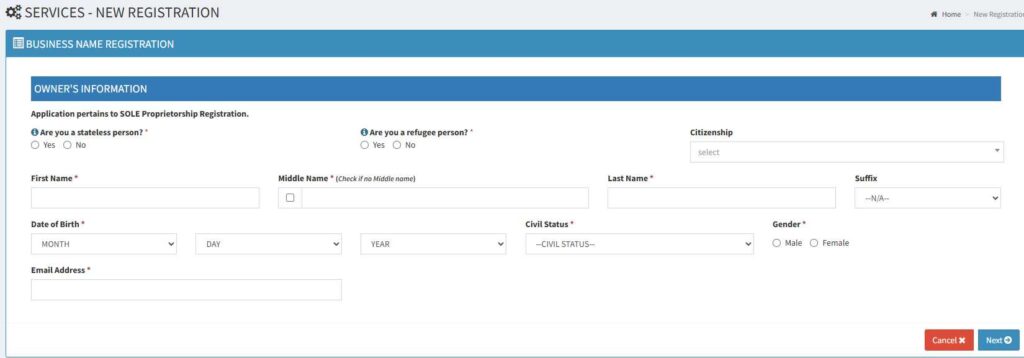
2. Fill Out Owner Details
Enter your full name, address, and birthdate exactly as shown on your ID. Any mismatch can cause delays in your verification process.
3. Encode Your Proposed Business Name
DTI requires two parts for your name:
- Dominant Name: Your unique brand (e.g., “Juan’s”).
- Business Descriptor: Your industry (e.g., “Coffee Shop”). Note: Descriptors follow the Philippine Standard Industrial Classification (PSIC).
4. Check Name Availability
Click “Check Name Availability.” If the system flags a conflict, try a more unique variation. Avoid generic terms like “The Laundry Shop.”
5. Pay the Registration Fee
Once you receive your Reference Code, pay via GCash, Maya, or Landbank.
Important: You must pay within seven (7) calendar days or your application will be cancelled.
6. Download Your Certificate
After payment, download your Certificate of Business Name Registration (CBNR). It is highly recommended to print a physical copy in color to display in your place of business.
Many small entrepreneurs report finishing the entire process in 30–45 minutes if they already have a name and payment method ready.
Expert tips for first-time registrants
Use the three-word rule
If your desired name is common, add a unique third word to avoid “similar name” rejections. For example, instead of “Manila Coffee,” try “Manila Sunrise Coffee” or “Manila Harbor Coffee.” This makes your brand more distinctive and easier to approve.
Avoid overly generic names
DTI generally does not allow purely generic names like “The Bakery” or “Manila Shoes.” Your business name must have a dominant element that clearly identifies your brand, not just the product or city.
Print your certificate in color
While digital copies are accepted in many situations, some banks and government offices still prefer a colored printout of your DTI certificate. Use good-quality paper and keep it in a clear folder to avoid damage.
Set a reminder for renewal
Your DTI registration is valid for five years. You can renew as early as six months before expiry. If you forget and let it lapse, someone else might register a similar name, or you may have to pay penalties or re-register under a new name.
What happens after DTI registration
DTI registration is only the first step. It gives you a legal business name, but it does not yet give you the full authority to operate. The DTI itself clarifies that you still need a business or mayor’s permit from your local government unit (LGU) to legally operate.
Barangay business clearance
Go to your barangay hall and apply for a Barangay Business Clearance. Bring your DTI certificate, valid ID, and sometimes proof of address or lease contract. Fees are usually modest but vary by barangay.
Mayor’s or business permit
Next, proceed to your city or municipal hall to apply for a Mayor’s Permit or Business Permit. Requirements often include your DTI certificate, barangay clearance, lease contract or tax declaration, and sometimes a simple sketch of your business location.
BIR registration
Register with the Bureau of Internal Revenue (BIR) to obtain your Taxpayer Identification Number (if you do not have one yet), register your business, and secure an Authority to Print (ATP) official receipts or use BIR-accredited invoicing systems.
This step is crucial if you want to issue official receipts and be compliant with taxes.
SSS, PhilHealth, and Pag-IBIG registration
If you plan to hire employees, you must register as an employer with SSS, PhilHealth, and Pag-IBIG. This allows you to remit mandatory contributions and avoid penalties later on.
Common challenges and how to handle them
Business name already taken
This is very common, especially for generic-sounding names. Prepare backup names and be ready to tweak your dominant name or add a unique word. Think of something that reflects your story, location, or specialty.
Confusion between DTI and SEC
Many beginners are unsure whether to go to DTI or SEC. A simple rule: if you are alone and the business is under your personal name, go to DTI. If you have partners, investors, or want a corporation, go to SEC.
Slow or unstable internet
If your internet connection is unreliable, try registering during off-peak hours (late evening or early morning), or use a computer shop with a stable connection. You can also save your reference code and return to payment later if needed.
Unfamiliarity with online payments
If you are not comfortable paying online, you can choose over-the-counter options supported by the BNRS system. Just follow the instructions and keep your payment receipt until your certificate is confirmed.
Conclusion
Registering your business with the DTI is one of the most important first steps in turning your idea into a real, recognized enterprise. It gives you a legal identity, opens doors to banks and payment platforms, builds customer trust, and prepares you for bigger opportunities like government contracts and corporate clients.
Whether you are a sari-sari store owner, an online seller, a freelancer, or an OFW planning to start a small business back home, DTI registration is both affordable and accessible. With a valid ID, a good business name, and a few hundred pesos, you can complete the process online in less than an hour.
Treat this step as your foundation. Once your name is registered, continue the journey: secure your barangay and mayor’s permits, register with the BIR, and set up your systems for payroll, contributions, and proper record-keeping. Each step brings you closer to a business that is not just surviving, but ready to grow.